Temple of Apollo Daphnephoros: The Sacred Heart of Ancient Eretria
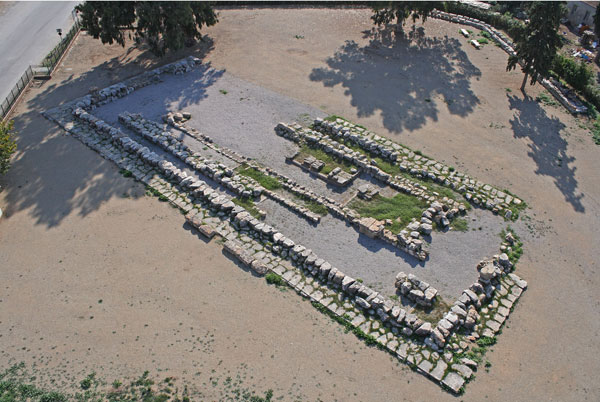
The Temple of Apollo Daphnephoros is the most important and renowned archaeological monument in Eretria. Together with its surrounding enclosure wall, it formed the sacred precinct of Apollo, serving as the city’s primary religious centre and most significant place of worship. Located in the heart of ancient Eretria, just north of the agora, the sanctuary played a central role in the city’s spiritual and civic life.
According to the Homeric Hymn to Apollo, the god arrived at the fertile Lelantine Plain while searching for a place to establish his oracle. This connection highlights the region’s long-standing religious significance and its association with the worship of Apollo.
The Earliest Temple of Apollo Daphnephoros in Eretria
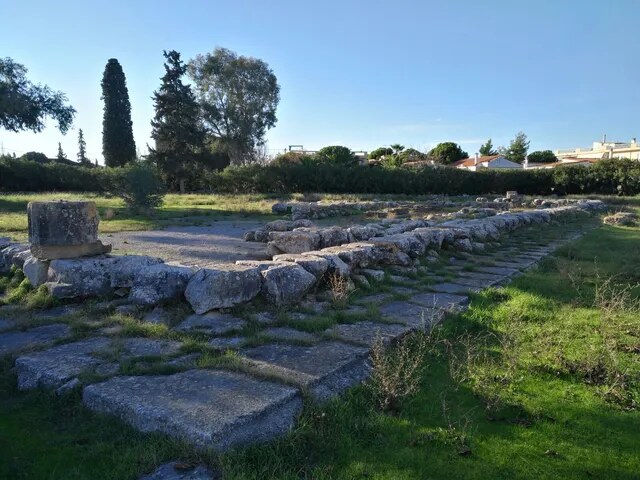
The first Temple of Apollo Daphnephoros dates to the Geometric period. Archaeological evidence suggests that it was originally located close to the harbour, as the sea extended into the area of the agora during that era. The structure was a remarkable hundred-foot-long apsidal building, making it one of the earliest temples of its kind in Greece. It was slightly later in date than the famous hundred-foot-long Temple of Hera on Samos and is among the oldest monumental temples mentioned by Homer.
Another important apsidal structure, known as the Daphnephorion, was discovered in southern Eretria. Measuring approximately 7.5 x 11.5 metres, it is considered the oldest known sanctuary in Eretria and is closely linked to the early worship of Apollo. Excavations revealed clay bases at the centre of the building that once supported laurel tree trunks, which formed part of the roof structure. The laurel tree, sacred to Apollo, gave the sanctuary its name, “Daphnephoros,” meaning “Bearer of the Laurel.”
The Archaic Temple of Apollo Daphnephoros and Its Development
At the beginning of the 6th century BCE, a second hundred-foot-long temple was constructed above the earlier Geometric sanctuary. This development followed extensive landfilling and the creation of a stable terrace. The new temple featured a wooden colonnade with six columns on its short sides and nineteen on its long sides, reflecting the growing importance of Apollo’s cult in Eretria.
Over time, this structure was also covered to make way for an even more impressive sanctuary. Construction of the third and most monumental Temple of Apollo Daphnephoros began between 520 and 490 BCE, during the late Archaic period. However, the project may not have been fully completed before the Persian invasion of Eretria in 490 BCE, when the city was destroyed during the Greco-Persian Wars.
A Must-Visit Archaeological Site in Eretria
Today, the Temple of Apollo Daphnephoros remains one of the most significant archaeological attractions in Eretria and on the island of Euboea. Its rich history, architectural evolution, and deep connection to the worship of Apollo make it an essential stop for visitors interested in Ancient Greek history, archaeology, and culture.