A remarkable civilisation
The Minoan civilisation, which emerged on Crete, reached impressive levels of social and economic organisation and produced remarkable works of art. Its name is derived from the legendary King Minos of Knossos.
This Bronze Age civilisation of Crete and the Aegean islands flourished from roughly 2700 to 1450 BCE, then gradually declined, ending around 1100 BCE. The reasons behind the decline, which began around 1550 BCE, are unclear but may include invasions by the Mycenaeans from mainland Greece and the catastrophic volcanic eruption on Santorini.
As the first advanced civilisation in Europe, the Minoans left a legacy of grand architectural complexes, tools, exquisite artwork, the undeciphered Linear A script, and a vast trade network.
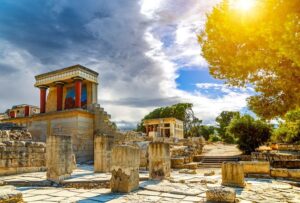
Minoan civilisation is especially famous for its grand, multistoried palaces, some reaching up to four stories. These palaces were complete with intricate plumbing systems and decorated with frescoes. The most renowned palace is Knossos, followed by Phaistos.
The main administrative and urban centres:
The civilisation was organised around large regional palace complexes, which were not fortified. The most important of these were located at:
- Knossos (the largest centre, with the archaeological site covering more than 20,000 square meters)
- Phaistos
- Malia
- Zakros
Key Aspects of Minoan Civilization
- Architecture and Palaces:
Minoan architecture is best known for its large, complex palace structures, especially at Knossos. These palaces were hubs of administration, religion, and economic activity, built around central courtyards. Adorned with colourful frescoes, they included advanced drainage systems and showcased the Minoans’ artistic and engineering skills. The absence of fortifications suggests a peaceful society or one confident in its naval power. - Art and Iconography:
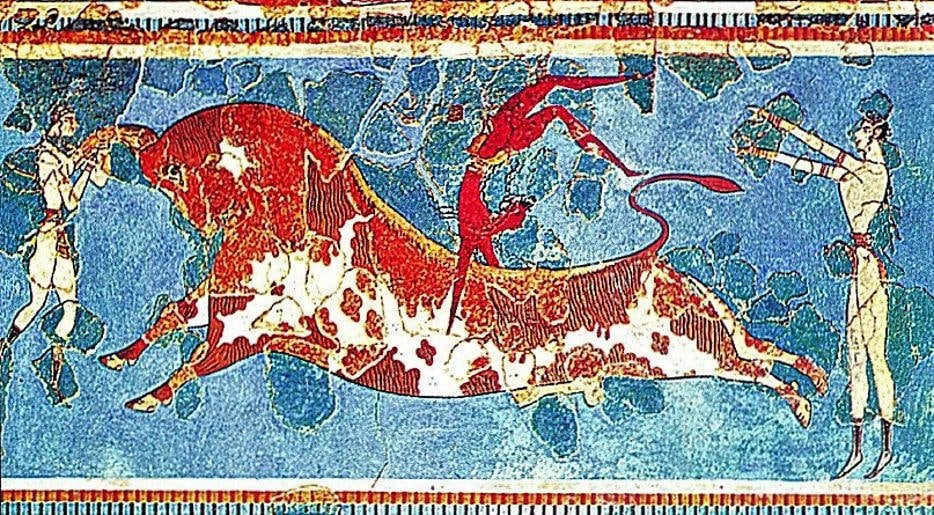
Minoan art shows a solid connection to nature, religion, and daily life. Frescoes often depicted marine life, animals, plants, and human figures engaged in rituals, sports (such as bull-leaping), and ceremonies. Minoan pottery is renowned for its intricate designs and bright colours, frequently featuring marine motifs that reflect the sea’s importance in Minoan life. - Religion and Society:
Minoan religion likely centred around a goddess symbolising fertility and nature, with accompanying deities or male counterparts. Religious practices took place in palaces, on sacred mountain peaks, and in caves, suggesting a spirituality tied to nature. Bulls were significant symbols of power and fertility, as seen in bull-leaping and the Minotaur myth. Women held prominent roles, often depicted as priestesses or leaders in Minoan art. - Economy and Trade:
The Minoans established an extensive trade network across the Mediterranean, trading pottery, olive oil, and wine with Egypt, the Near East, and Greece. Skilled sailors likely controlled key maritime routes, bringing wealth and influence and fostering cultural exchange that spread Minoan practices and art. - Language and Writing:
Minoans used Linear A, an undeciphered script probably for administration and religion. The lack of understanding of Linear A leaves parts of Minoan culture mysterious, though some insights come from artefacts. The Mycenaean Greeks later adapted Linear A into Linear B, an early Greek writing system.
Decline and Legacy
The Minoan civilisation began to decline around 1450 BCE, likely due to natural disasters and external pressures. The Thera volcanic eruption (modern Santorini) may have caused widespread devastation and economic difficulties. Eventually, the Mycenaean Greeks influenced Crete, adopting Minoan cultural elements and reusing some palaces. By 1100 BCE, Minoan culture had largely faded, though its influence persisted in Mycenaean and later Greek civilisations.
Enduring Influence
The Minoan civilisation established European art, architecture, and mythology. Myths linked to Crete, like those of the Minotaur and King Minos, remain central to Western heritage. The Minoans’ art, architecture, and cultural accomplishments reveal a highly sophisticated society with a legacy that inspires admiration today.