Epirus gastronomy is deeply shaped by the region’s climate, seasonal rhythms, and agricultural traditions. The eating habits of its people reflect both their close relationship with nature and their strong religious traditions. Local cuisine follows the Christian calendar, with many dishes connected to religious celebrations, fasting periods, and important social events.
One of the most distinctive features of Epirus gastronomy is its extraordinary variety of traditional pies. Alongside these famous pies, Epirus is known for its high-quality dairy products, including feta cheese, yellow cheeses, yoghurt, butter, and fresh milk. Epirus gastronomy also includes a rich selection of meats, including lamb, goat, pork, beef, chicken, and wild game, accompanied by local wine and tsipouro. Traditional desserts, often baked and infused with Eastern flavours and aromas, complete the culinary experience.
In Epirus, food and nature exist in perfect harmony. The mountains, villages, rivers, and stone-built settlements are filled with history, memories, and traditions preserved through generations. The people of the region continue to honour old customs, hospitality, and human connection, making food not simply nourishment but a full sensory and cultural experience.
Dominated by the rugged Pindos mountain range, Epirus is a land of wild beauty, harsh winters, and rich natural resources. Its dramatic landscape has shaped both the character of its people and its deeply authentic cuisine. Those who truly experience Epirus often find themselves wanting to return again and again.
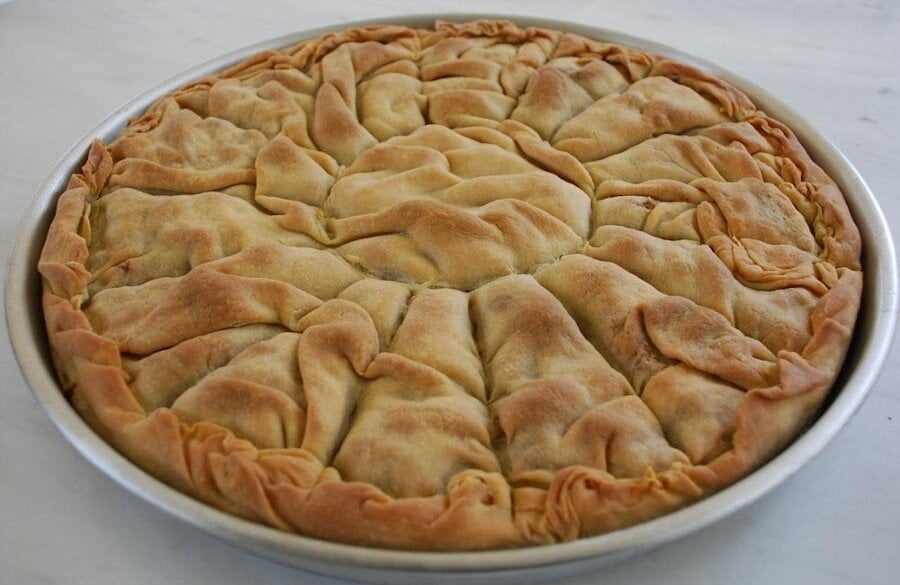
As folklore professor Michalis G. Meraklis famously said, “Tradition is not something abstract or theoretical. You experience it by eating a delicious Epirus pita.” Indeed, Epirus is often described as a true paradise of pies.
According to author and dietician Andreas Stefopoulos, 31 different varieties of pita have been documented in 15 villages of Epirus, with recipes changing from village to village and region to region. These pies are traditionally served as main dishes or as accompaniments to meals, rather than as bread. Housewives prepared them to welcome guests, feed craftsmen and workers, and bring creativity into everyday cooking.
In earlier times, pies were baked using traditional methods in wood-fired ovens, either on hot stones or in large baking trays and clay casseroles. Today, these recipes remain an essential part of the cultural identity and culinary heritage of Epirus. Here are some of them:
Alevropita or kourkoutopita: made with flour, eggs, white grated cheese, milk, and butter. It is eaten very hot, cut into pieces, as a welcome treat.
Pispilita or Blatsaria: naked (without filo) pita with corn flour, wild greens, trahana, cheese, olive oil, and butter. The nettle pie is similar, but with filo.
Cassiata: pita with filo, olive oil, butter, and feta cheese. Its peculiarity is that the filo layers alternate in the pan with and without cheese. When baked, the result is like cheese millefeuille!
Mintita (pumpkin pie): naked pie (without filo) with corn flour, pumpkin, trahana, cheese, butter, and olive oil.
Pita strifti (‘twisted pie’): pita with filo layers and a filling of leeks, cheese, trahana, olive oil, and butter.
Tyrogliata: pita with fresh cheese from Metsovo.
Galatopita is a sweet pita with filo, eggs, sheep’s milk, and sugar. The filo layers are laid in a pan, filled with a cream made from flour and eggs, covered with more filo layers, brushed with butter and egg, and baked in the oven.
Pita with zigouri (lamb): the most complicated pie of winter (mainly Carnival) when the lambs have grown up. There are many layers of filo around and inside: trahana, milk, eggs, and meat.
Other local dishes:
Rithanadema: a special pilaf baked in the oven in a pan where the rice gradually draws the broth of the chicken that has been boiled first. The rice is then mixed with sauteed onions, parsley, and grated feta cheese, while the chicken meat is placed in the centre, with pieces of butter on top.
Leeks with plums: leeks, onion, olive oil, tomato juice, nutmeg, salt and pepper.
Eel with laurel leaves on the tiles: Eels abound in the lake of Ioannina. This dish is distinguished by its finesse. Laurel leaves are placed between the slices of fish, sealed at the edges with dough, and release their aroma when baked on tiles.
The local Horta: poppy (Sourlina), Zochia, Genia Tou Papa (‘priest’s beard’), psaroulia, wild carrot, ktenaki, nettle, bruva or lapsana, thistle, moscholachano, celery or paza, and spinach. Let us say here that Pindos is rich in wild herbs, many of which are aromatic.
Karavides (crayfish) skordalia: We find them on the island of Kyra Frosini in the lake of Ioannina in the numerous taverns serving frog legs, trout, and fish. This is a delicious dish in which the crayfish are first boiled and shelled. Their shells are used to prepare a rich skordalia with walnuts, and a little of the shell’s broth is served on top of the fried, shelled crayfish.
Amvrakikos Gambares (shrimp of Amvrakikos Gulf) with garlic: a dish made preferably with fresh garlic, which is steamed in a saucepan over low heat. Fresh tomatoes and olive oil are then added to the shelled shrimp.
Goumidia: a type of fricassee made with lamb liver and head, onions, parsley, dill, spearmint, cabbage or spinach, white wine, and butter. Beaten egg whites are added during cooking to thicken the texture.
Leeks with Metsovo meatballs: meatballs made from mutton and beef, onion, parsley, eggs, trahana, oregano and red pepper. After the meatballs are kneaded and formed, they are boiled on a layer of sauteed leeks with celery and tomato juice.
Gigantes (‘giants’) with wild horta: huge beans boiled with mountain horta, onion, tomato juice, spearmint, parsley, and garlic.
Dairy Products:
Epirus is rich in dairy products, such as yoghurt, chlorotiri, pagouda, afrogalo, galotiri, gouliastra and trofali. Do not forget the latest products, such as Metsovone, feta, and kefalograviera.
Wine:
When we talk about continental wines, we refer to the vineyards of Metsovo and Zitsa. Greece’s most mountainous vineyard, Metsovo, impresses with its sloping vineyards, which create beautiful natural ‘paintings’ perched on the steep mountain slopes in spring and summer.
Further to the west is the plateau of Zitsa, the “kingdom” of Debina, the elegant white variety distinguished by both its still and sparkling wines.
In Zitsa, we have PDO white wines, both still and sparkling, exclusively from 100% Debina.
Metsovo produces both red and white PGI wines from Cabernet Sauvignon, Merlot, Cabernet Franc, Gewürztraminer, Debina, and Vlachiko.
Protected Designation of Origin (PDO) and Protected Geographical Indication (PGI) products:
| Product | Designation of Origin and Geographical indication | Prefecture |
| Olive oil | Preveza (PGI) | Preveza |
| Olives | Konservoelia (PGI) | Arta |
| Cheese | Metsovone (PDO) | Ioannina |
| Cheese | Feta (PDO) | Arta, Thesprotia, Ioannina, Preveza |
| Cheese | Kefalograviera (PDO) | Arta, Thesprotia, Ioannina, Preveza |
| Cheese | Galotiri (PDO) | Arta, Thesprotia, Ioannina, Preveza |
| Wine | Ipiros (PGI) | All prefectures |
| Wine | Zitsa (PDO) | Ioannina |
| Wine | Metsovo (PGI) | Ioannina |
| Wine | Ioannina (PGI) | Ioannina |