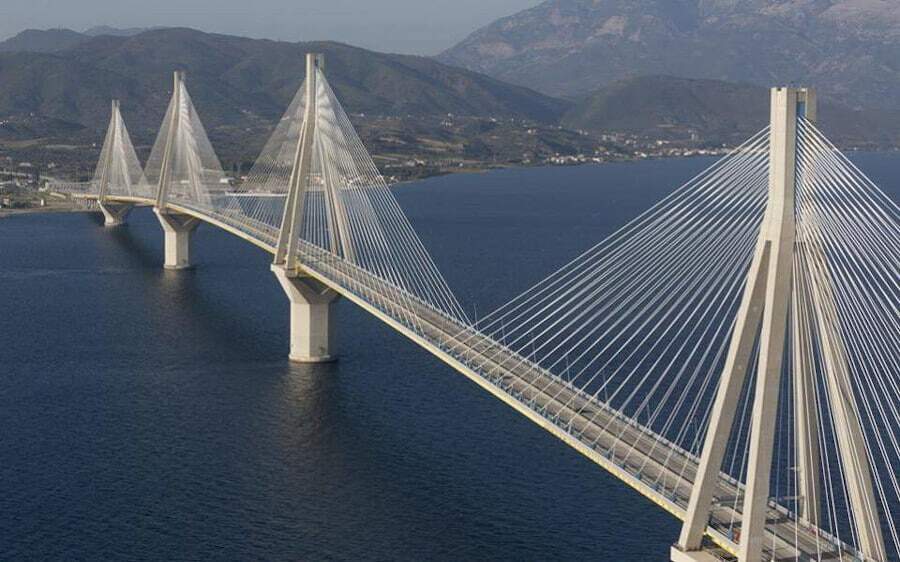
The Rio-Antirio Bridge or Charilaos Trikoupis Bridge: The Engineering Marvel of the Gulf of Corinth
Charilaos Trikoupis Bridge, widely known as the Rio–Antirio Bridge, is one of the most remarkable engineering achievements in the world and one of modern Greece’s most recognisable landmarks. Spanning the Gulf of Corinth near Patras, it connects Rio in the Peloponnese with Antirrio in Central Greece, creating a vital transportation link between the two regions.
The bridge officially opened on 12 August 2004, just one day before the start of the Athens Olympic Games, and played an important role in transporting the Olympic flame. Today, it stands as a symbol of innovation, connectivity, and engineering excellence.
A Vision More Than a Century Old
The concept of linking the two shores was first proposed in the late 19th century by the Greek statesman Charilaos Trikoupis, whose name the bridge proudly bears. For decades, however, the site’s technical challenges made construction impossible.
Only with advances in modern engineering could this ambitious vision become a reality. Construction began in the late 1990s, culminating in one of Europe’s most significant infrastructure projects of the early 21st century.
One of the World’s Great Engineering Achievements
The Rio-Antirio Bridge is recognised internationally as one of the world’s longest multi-span cable-stayed bridges and remains the longest fully suspended bridge of its type.
Stretching approximately 2,380 metres across the Gulf of Corinth, with a cable-stayed deck extending 2,252 metres, the bridge ranks among the longest cable-stayed bridge structures ever built. Its elegant design features four massive pylons supporting five spans through a complex network of cables that create its distinctive silhouette.
The bridge deck is 28 metres wide and accommodates two traffic lanes in each direction, emergency lanes, and a dedicated pedestrian walkway, offering spectacular views across the gulf.
Overcoming Extraordinary Challenges
What makes the Rio-Antirio Bridge particularly remarkable is the extreme difficulty of the environment in which it was built. Engineers had to overcome deep waters, unstable seabed conditions, strong winds, significant seismic activity, and the constant tectonic movement that characterises the region.
Innovative construction techniques and advanced seismic design solutions were developed specifically for the project, making the bridge a globally recognised case study in modern engineering. Its ability to withstand earthquakes and challenging geological conditions is considered one of its greatest achievements.
Gateway to Western Greece
Before the bridge was constructed, travellers crossing between the Peloponnese and mainland Greece relied primarily on ferries or lengthy journeys via the Isthmus of Corinth. The bridge dramatically improved accessibility, reducing travel times and strengthening economic and tourism connections throughout western Greece.
Today, the Rio-Antirio Bridge serves as a gateway to some of Greece’s most attractive destinations, including Patras, Nafpaktos, the Peloponnese, and the wider Gulf of Corinth region.
Gastronomy and Experiences Nearby
The areas surrounding the bridge offer visitors a rich combination of history, coastal scenery, and gastronomy. Travellers can enjoy seafood from the Gulf of Corinth, local wines, olive oil, cheeses, and traditional Greek cuisine in the nearby towns and villages.
The bridge also serves as an ideal starting point for food tours and culinary experiences that showcase the diverse flavours of both Central Greece and the Peloponnese.
A Symbol of Modern Greece
More than a transportation link, the Rio-Antirio Bridge represents the successful combination of vision, technology, and human ingenuity. Its elegant architecture and groundbreaking engineering have earned it international recognition as one of the great bridge-building achievements of modern times.
Combining spectacular views, strategic importance, and engineering brilliance, the bridge remains one of Greece’s most impressive modern landmarks and a must-see destination for visitors exploring western Greece.