Where Greek, Roman & Early Christian Worlds Converge
Philippi is one of the most important archaeological sites in Greece and a UNESCO World Heritage Site, located near the modern settlement of Krinides in Eastern Macedonia. Renowned for its exceptional historical significance, the site preserves an extraordinary sequence of Greek, Roman, and early Christian monuments within a single archaeological landscape.
Founded by Philip II of Macedon in the 4th century BCE, Philippi later flourished as a major Roman colony and became a pivotal centre in the spread of Christianity throughout Europe. Its remarkably preserved ruins include an ancient theatre, forum, city walls, basilicas, and other monuments that reflect more than a millennium of continuous history.
Situated between the fertile plain of Drama and the hills that extend toward Kavala, Philippi offers visitors a unique opportunity to explore a city that profoundly influenced both classical civilisation and early Christianity. Today, it remains one of northern Greece’s most important cultural landmarks, attracting travellers, historians, and pilgrims from around the world.
A Glimpse into the History of Philippi
The site was originally founded in the 4th century BCE by King Philip II of Macedon, who fortified the settlement and gave it his name. Its strategic position controlled the route between Macedonia and Thrace, as well as the nearby gold-bearing region of Mount Pangaion.
Philippi became world-famous after the Battle of Philippi. In this decisive Roman civil war, the forces of Octavian and Mark Antony defeated the armies of Brutus and Cassius, marking the end of the Roman Republic and paving the way for the rise of the Roman Empire.
During the Roman period, Philippi prospered as a colony along the Via Egnatia, the great road linking the Adriatic with the eastern Mediterranean. The city later gained immense religious importance in the 1st century CE when the Apostle Paul visited Philippi, founded one of the earliest Christian communities in Europe, and preached to Lydia of Thyatira near the city. This connection makes Philippi a major pilgrimage destination for Christian visitors worldwide.
The Landscape of Philippi
Philippi lies in a fertile plain historically linked to agriculture, trade, and movement across northern Greece. The surrounding region produces cereals, vegetables, olives, wine, and other agricultural products that continue to shape local life today.
The nearby wetlands and foothills of Mount Pangaion add ecological diversity to the area, while the proximity of Kavala provides easy access to the Aegean coast.
Hellenistic and Roman Periods
Philippi flourished during the Hellenistic era, developing into a well-organised ancient city with:
- defensive city walls
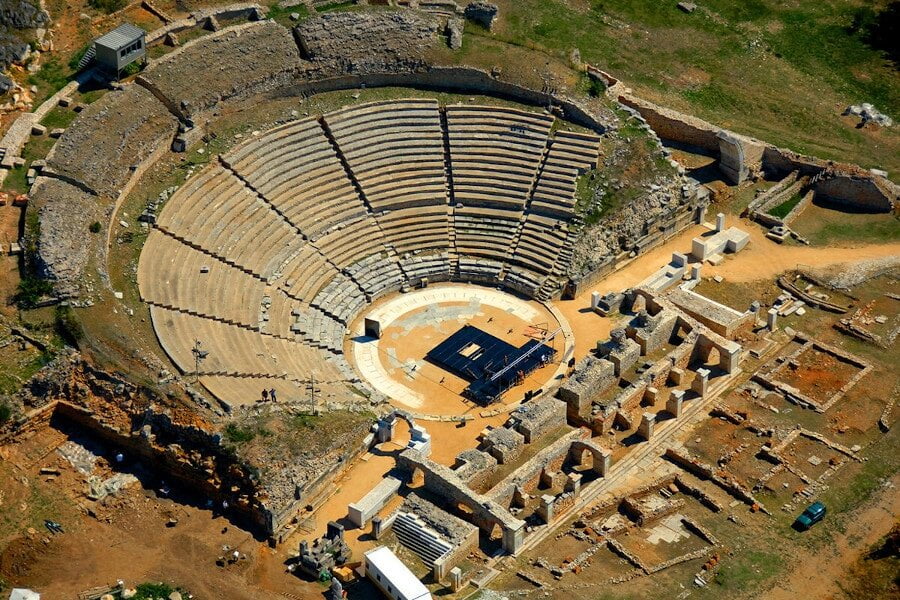
- a theater
- public buildings
- residential areas
In 42 BCE, after the Battle of Philippi, the city became a Roman colony. Under Roman rule, Philippi grew into an important administrative, economic, and cultural centre in the region of Macedonia.
Early Christianity in Philippi
Decline and Abandonment
From the early 7th century CE, Philippi began to decline due to devastating earthquakes and Slavic invasions. Although it survived as a Byzantine fortress for a time, it was gradually abandoned. The final phase of abandonment came after the Ottoman conquest at the end of the 14th century.
What You Can See Today (UNESCO Site)
The archaeological site preserves monuments from multiple periods, allowing visitors to trace the city’s evolution over more than a thousand years. Philippi remains a key UNESCO World Heritage Site, attracting tourists, historians, and archaeologists from around the world who want to experience the layered history of Macedonia and ancient Greece. Today, Philippi is a protected archaeological site and one of the most important historical landmarks in Greece. Visitors can explore:
| Monument | Highlights |
|---|---|
| Ancient Theatre | Originally built in the Hellenistic period and later modified by the Romans; still used for cultural performances and the Philippi Festival. |
| Roman Forum (Agora) | The civic and commercial heart of Roman Philippi, surrounded by public buildings and monumental architecture. |
| Early Christian Basilicas | Large 5th–6th century churches that testify to Philippi’s importance as a major Christian centre in the Byzantine era. |
| Prison of Paul (traditional identification) | A site traditionally associated with the imprisonment of the Apostle Paul, though the identification is based on later tradition rather than definitive archaeological proof. |
| City Walls & Urban Remains | Fortifications, streets, baths, and residential remains illustrate the city’s long occupation history. |