The 1923 Population Exchange: The Trauma That Reshaped Two Nations
On January 30, 1923, the Convention Concerning the Exchange of Greek and Turkish Populations was signed in Lausanne. It marked an unprecedented moment in modern history: for the first time, an international treaty imposed the compulsory relocation of entire populations solely on the basis of religion. The agreement formalised the end of the Asia Minor Catastrophe and permanently transformed the demographic, political, and cultural landscape of both Greece and Turkey.
The Causes of the Population Exchange
The Convention was not the result of a sudden diplomatic decision. It emerged from a series of dramatic military, political, and ideological developments that had already destabilised the region.
The Asia Minor Catastrophe (1922)
The collapse of the Greek military front in August 1922 triggered the chaotic flight of hundreds of thousands of Greeks from Asia Minor. The destruction of Smyrna and the widespread persecutions that followed forced most of the Christian population to flee to Greece even before any official treaty was signed. In many ways, the exchange merely legalised an already existing refugee crisis.
Turkey’s Refusal to Permit Return
During the negotiations, Mustafa Kemal Atatürk made clear that the Greek refugees would not be allowed to return to their homes. The new Turkish state viewed the continued presence of large Christian populations as a threat to national security and sought the complete removal of the Greek element from Anatolia.
The Rise of Nationalism
The collapse of the multi-ethnic Ottoman Empire accelerated the rise of nation-states throughout the region. Both the Greek Megali Idea and the Turkish nationalist movement promoted the ideal of ethnic and religious homogeneity. At the time, many diplomats considered multicultural coexistence a source of recurring conflict and instability.
The International Initiative of Fridtjof Nansen
Fridtjof Nansen, the League of Nations’ High Commissioner for Refugees, officially proposed the compulsory exchange. His reasoning was primarily humanitarian: he believed that a complete separation of populations was the only way to prevent further massacres and establish lasting peace between the two countries.
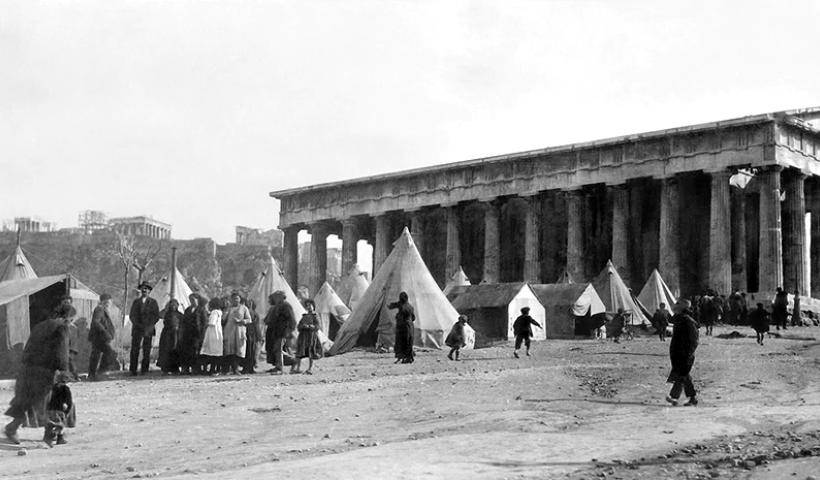
Greece’s Refugee and Housing Crisis
Greece faced the urgent challenge of accommodating more than one million impoverished refugees. The departure of Muslims from Greece freed homes, farmland, and businesses—especially in Macedonia and Thrace—which were redistributed to incoming refugees from Asia Minor, helping them rebuild their lives.
Religion as the Criterion of Separation
The most controversial aspect of the Convention was its strict reliance on religion rather than ethnicity or language.
- All Orthodox Christians living in Turkey were classified as “Greeks,” even if they spoke only Turkish, such as the Karamanlides.
- All Muslims living in Greece were classified as “Turks,” even when their native language was Greek, such as the Valaades of Macedonia.
As a result, religious identity became the defining factor in determining nationality and belonging.
The Scale of the Exodus
The population exchange evolved into one of the largest forced migrations of the twentieth century, affecting nearly two million people.
Population Movements
- Approximately 1.2 to 1.3 million Orthodox Christians arrived in Greece from Asia Minor, Pontus, and Eastern Thrace.
- Between 350,000 and 500,000 Muslims departed from Greece for Turkey.
Most of those displaced became refugees overnight, losing both their homes and, legally, the citizenship of the countries they were forced to abandon.
Exceptions to the Agreement
To preserve a degree of political balance, certain communities were excluded from the exchange:
- The Greek inhabitants of Constantinople (Istanbul), Imbros (Gökçeada), and Tenedos (Bozcaada)
- The Muslim inhabitants of Western Thrace
The exclusion of the Muslims of Western Thrace explains the continued Muslim presence in the region today.
The Impact on Greece
The sudden influx of refugees placed enormous pressure on the already exhausted Greek state. Yet, over time, the refugees contributed significantly to the country’s economic and cultural development.
Demographic Transformation
Within only a few months, the population of Greece increased by nearly 20 per cent, dramatically altering the country’s demographic structure.
Ethnic Consolidation
Macedonia and Thrace acquired a stronger Greek majority, replacing much of their previous multicultural composition.
Economic Development
Refugees introduced valuable expertise in commerce, crafts, silk production, tobacco cultivation, and industries such as carpet weaving. Their labour and entrepreneurial skills stimulated economic growth and urban expansion.
Cultural Enrichment
The refugees profoundly influenced modern Greek culture. Their traditions transformed Greek music, literature, cuisine, and social life. The emergence of rebetiko music, in particular, became one of the most enduring cultural legacies of the Asia Minor refugees.
An Open Historical Wound
Despite contributing to the long-term stabilisation of both Greece and Turkey, the Population Exchange remains one of the deepest traumas in the modern history of the Eastern Mediterranean.
Hundreds of thousands of families were violently uprooted from ancestral homelands where they had lived for centuries. Many endured deaths, disease, poverty, and hardship during the journey and resettlement process. The pain of displacement, the loss of property and identity, and the struggle for integration have created a collective memory passed down through generations.
For Greeks and Turks alike, the memory of the “Lost Homelands” continues to shape historical consciousness, cultural identity, and relations between the two nations.