
The Magical Lantern Festival Celebrating the Discovery of the Miraculous Icon
Every year on January 30, the island celebrates the Fanarakia Lantern Festival of Tinos, commemorating the 1823 discovery of the miraculous icon of the Annunciation (Evangelismos) of the Virgin Mary. One of the island’s most cherished religious and cultural traditions, the celebration brings together locals, schoolchildren and visitors for a spectacular lantern-lit procession through the streets of Chora, the island’s main town.

During the festivities, the streets fill with people carrying wooden poles decorated with colourful, illuminated lanterns, “fanarakia”. Accompanied by traditional hymns and festival chants, the procession recreates the atmosphere of the night when islanders first gathered to venerate the newly discovered icon.
The History Behind the Lanterns “Fanarakia”: The Discovery of the Icon
The story of the lanterns, “Fanarakia”, is closely connected with the visions of Saint Pelagia, a nun at the Monastery of Kechrovouni. According to religious tradition, in July 1822, the Virgin Mary appeared to Pelagia in a series of dreams over three consecutive Sundays, revealing the location of a buried icon and asking that excavations be organised to find it.
Following her visions, Pelagia informed the ecclesiastical authorities, and the islanders began excavating a site in Chora. After initial unsuccessful attempts, the excavation work resumed with renewed determination.
On January 30, 1823, a worker’s pickaxe struck an object buried in the ground. The excavation revealed two fragments of a wooden icon depicting the Annunciation: one showed the Archangel Gabriel holding a lily, while the other portrayed the Virgin Mary seated on a throne. Together, the two pieces formed the sacred image that is now preserved at the Church of Panagia Evangelistria, covered with votive offerings.
News of the discovery quickly spread throughout Tinos. Villagers from across the island made their way to Chora to venerate the icon, arriving on foot after nightfall and carrying oil lanterns to light their way. This historic gathering inspired the annual custom of the Fanarakia.
The icon’s first formal procession took place on February 2, 1823, the Feast of the Presentation of Jesus at the Temple (Hypapante). The anniversary of January 30 subsequently became an established annual celebration commemorating the discovery.
The Fanarakia Lantern Festival of Tinos: The Lantern Procession Through Chora
Every January 30, Tinos comes alive with the colourful Fanarakia celebrations. Schoolchildren play a central role in the festivities, preparing and carrying handmade lanterns decorated with colourful transparent materials. Their creations often feature religious symbols, boats and other imaginative designs.

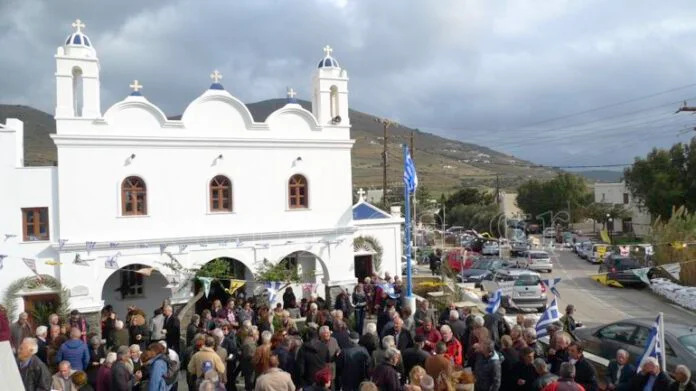
As evening approaches, students, locals and visitors gather in the courtyard of the Church of Panagia Evangelistria. From there, the lantern procession winds through the narrow streets of Chora, accompanied by the island’s Philharmonic band, hymns and traditional songs.
The procession makes its way towards the port, where prayers are offered, and fireworks illuminate the harbour sky, often accompanied by displays from boats anchored in the bay. The celebration concludes with the procession’s return to the church.
The Fanarakia are more than a religious commemoration. They are a living expression of Tinos’ faith, identity and community spirit, preserving a tradition that has connected generations of islanders for more than two centuries.
Traditional Food and Gastronomy of Tinos
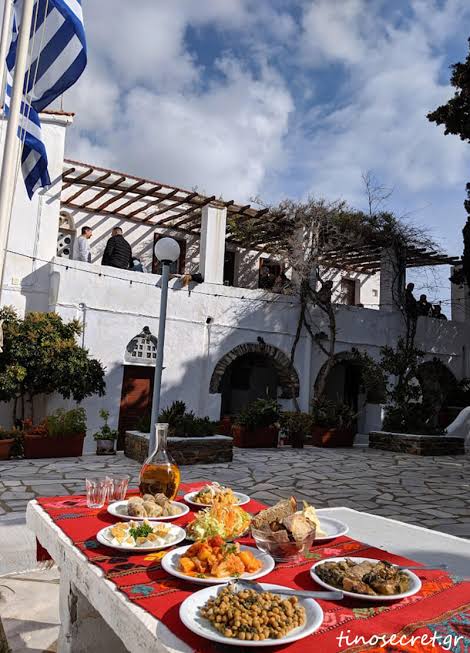
A visit to Tinos is also an opportunity to discover its distinctive local gastronomy, deeply rooted in the island’s agricultural heritage and culinary traditions.
Artichokes are among the island’s most celebrated agricultural products and feature in numerous recipes, including artichokes cooked à la polita, grilled artichokes and artichoke pies. Other traditional specialities include sun-dried tomatoes fried in batter, froutalia (a traditional omelette with potatoes and local sausage), savore with grape molasses, and locally produced pork sausages.
Tinos is also renowned for its cured meats, particularly louza, a delicately spiced, air-dried pork speciality, and saltsisi, the island’s traditional garlic-flavoured salami.
The island’s cheesemaking tradition is equally important. Among its best-known cheeses are Tinos graviera, the spicy, creamy kopanisti, petroma, and the characteristic spherical volaki cheese.
For those with a sweet tooth, local specialities include amygdalota (almond sweets), xerotigana (crispy fried pastries drizzled with honey), karidota (walnut sweets), pasteli (sesame and honey bars), loukoumia and various types of halva. Tinos is also known for its aromatic thyme honey, another prized local product.
The Fanarakia Lantern Festival of Tinos offer a wonderful opportunity to experience Tinos beyond its landscapes and villages. Combining religious devotion, local traditions and the island’s warm hospitality, this January celebration provides a memorable glimpse into the authentic cultural life of the Cyclades.
JANUARY 30 indicative program · MAIN FESTIVAL DAY, needs to be checked
| Time | Event |
|---|---|
| 07:30 | Festive church bells ring throughout Chora. The Philharmonic band plays through the town’s streets, followed by the morning religious service (Orthros). |
| 09:00 | Solemn Divine Liturgy at the Church of Panagia Evangelistria |
| 10:35 | Memorial service and wreath-laying ceremony in honour of Bishop Gabriel |
| 14:00 | Religious procession of the miraculous icon through the streets of Chora, with prayers and a ceremony at Pantanassa Square near the port |
| 16:30 | Grand Vespers service |
| 18:30 | Traditional Fanarakia lantern procession through the streets of Chora, accompanied by the Philharmonic band, students and local residents |
| Evening | Arrival at the harbour, celebrations and fireworks illuminating the port |
Important note: Two separate processions take place on January 30: the religious procession of the miraculous icon, traditionally held in the early afternoon, and the evening lantern procession (Fanarakia), the celebration’s most distinctive visual highlight.
The times above are based on the published programme for the 203rd anniversary in 2026. The programme for future years may change.
Photo: efsyn.gr tinostoday.gr