The Sacred Island of Apollo and Artemis and One of Greece’s Greatest Archaeological Treasures
Delos is one of the most important archaeological sites in Greece and among the most sacred islands of the ancient Greek world. Located at the heart of the Cyclades, between Mykonos and Rineia, Delos was revered in antiquity as the mythical birthplace of Apollo, god of light, music, prophecy, and the arts, and his twin sister Artemis, goddess of the hunt and nature.
Today, the entire island is an open-air archaeological museum and a UNESCO World Heritage Site, preserving one of the most complete ancient urban landscapes in the Mediterranean. Although permanently uninhabited, Delos attracts thousands of visitors each year to explore its temples, sanctuaries, marketplaces, theatres, and remarkably well-preserved houses, offering an unparalleled journey into the world of ancient Greece.
A Sacred Island Through the Ages
According to Greek mythology, Delos emerged from the sea to provide refuge for the goddess Leto, who gave birth to Apollo and Artemis beneath a sacred palm tree. Because of this divine association, the island became one of the most important religious centres of antiquity, attracting pilgrims from every corner of the Greek world.
Archaeological evidence indicates that Delos was inhabited from the 3rd millennium BCE. During the Archaic and Classical periods, it evolved into a major Panhellenic sanctuary, while in the Hellenistic era it became one of the Mediterranean’s busiest commercial ports and cosmopolitan cities.
Its strategic position in the centre of the Aegean transformed Delos into an international trading hub where merchants from Greece, Egypt, Syria, Asia Minor, Italy, and the wider Mediterranean exchanged goods, ideas, and cultures. At its height during the 2nd century BCE, the island was home to tens of thousands of inhabitants representing many different ethnicities, religions, and languages.
One of the Greatest Archaeological Sites in Greece
Walking through Delos is like stepping into a remarkably preserved ancient city. Unlike many archaeological sites that consist mainly of temples or isolated monuments, Delos preserves an entire urban landscape.
Visitors can explore the Sanctuary of Apollo, ceremonial avenues, marketplaces, public squares, luxurious private residences, theatres, cisterns, warehouses, and sophisticated drainage systems, all of which demonstrate the advanced urban planning of the ancient city.
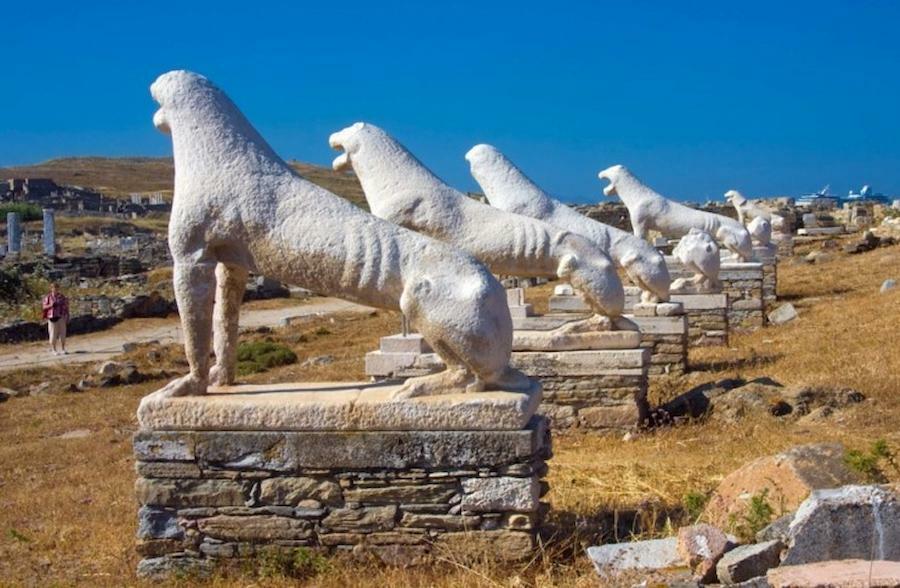
Among the island’s most famous monuments is the Terrace of the Lions, where elegant marble lions, dedicated by the people of Naxos during the 7th century BCE, once guarded the Sacred Way leading to Apollo’s sanctuary.
Other highlights include the House of Dionysus with its magnificent mosaics, the House of Cleopatra, the Sacred Lake, the Temple of Isis, the ancient theatre, the Stadium Quarter, and the impressive commercial districts that reveal the wealth generated through international trade.
A Cosmopolitan Centre of Antiquity
During the Hellenistic and Roman periods, Delos became one of the world’s earliest truly international cities. Merchants, sailors, bankers, craftsmen, and pilgrims created a multicultural society where Greek, Egyptian, Syrian, Phoenician, Roman, and Jewish communities lived and traded side by side.
Temples dedicated to foreign deities stood alongside Greek sanctuaries, reflecting the island’s remarkable religious tolerance and cultural diversity. This cosmopolitan character made Delos one of the Mediterranean’s most influential commercial centres before its decline in the late 1st century BCE following repeated invasions and piracy.
The Archaeological Museum of Delos
The Archaeological Museum of Delos houses one of Greece’s finest collections of ancient sculpture, pottery, inscriptions, mosaics, and everyday objects recovered during excavations.
Its masterpieces include the original marble lions, statues of Apollo, exquisite mosaic floors, jewellery, household items, and inscriptions that illuminate the daily life, religion, commerce, and artistic achievements of ancient Delos.
A Landscape of Sacred Simplicity
Unlike the lush landscapes of many Greek islands, Delos is characterised by rocky hills, low vegetation, granite outcrops, and panoramic views across the Cyclades. This austere landscape contributes to the island’s unique atmosphere and reinforces its sacred identity.
The highest point, Mount Kynthos, offers breathtaking views over the surrounding islands and was itself an important place of worship in antiquity.
Gastronomy and Nearby Cycladic Flavours
As a protected archaeological site, Delos has no permanent residents, hotels, restaurants, or commercial facilities. Visitors typically arrive on day trips from nearby Mykonos or other Cycladic islands.
To experience the gastronomy of Delos, travellers can enjoy the rich culinary traditions of neighbouring Mykonos, Rinia, and the Cyclades. The region is renowned for fresh seafood, artisan cheeses, sun-ripened vegetables, capers, olives, local herbs, handmade pies, traditional sweets, and wines produced from indigenous grape varieties.
Many visitors combine a morning exploring Delos with a leisurely lunch overlooking the Aegean, where classic Cycladic cuisine perfectly complements the island’s extraordinary historical setting.
UNESCO World Heritage Site
Recognising its exceptional cultural significance, UNESCO inscribed Delos on the World Heritage List in 1990. The island is regarded as one of the world’s most important archaeological sites because of its outstanding testimony to ancient Greek religion, urban planning, commerce, and multicultural exchange.
Continuous archaeological research and conservation efforts ensure that this unique monument remains preserved for future generations.
Discover the Sacred Island of Delos
Delos is far more than an archaeological site. It is the mythical birthplace of Apollo, a sacred sanctuary, a thriving ancient metropolis, and one of the greatest centres of commerce and culture in the Mediterranean.
Combining mythology, exceptional archaeology, UNESCO-recognised heritage, and breathtaking Aegean scenery, Delos offers one of the most unforgettable cultural experiences in Greece and remains an essential destination for anyone seeking to understand the ancient Greek world.