What Happens at a Traditional Greek Panigiri?
A Celebration of Faith, Food, Music and Dancing
A panigiri is a traditional Greek religious and village festival that brings an entire community together to honour a patron saint or celebrate an important religious feast day. For visitors unfamiliar with Greek customs, a panigiri is a unique cultural experience that combines Orthodox Christian traditions, communal dining, live folk music, traditional dancing, and the famous Greek spirit of hospitality.
But what exactly happens at a panigiri? The celebration usually unfolds in several stages, each with its own traditions and atmosphere.
1. The Religious Ceremony – Honouring the Patron Saint
The celebrations traditionally begin at the local church, where residents gather for an evening service known as Festive Vespers, usually held on the eve of the saint’s feast day.
The service includes prayers, hymns and, in some celebrations, Artoklasia, the blessing of five loaves of bread. On the feast day itself, they usually celebrate a Divine Liturgy.
In some villages, a procession carrying the patron saint’s icon may also take place. These religious traditions are at the heart of the panigiri, giving the celebration its spiritual meaning.
2. The Communal Feast – Sharing Traditional Greek Food
Following the religious service, the celebration moves to a village square, courtyard, community venue or outdoor estate.
Long tables are prepared, and locals and visitors gather to enjoy a communal meal. Food is an essential part of every panigiri, with traditional recipes and regional specialities taking centre stage.
Depending on the island and local customs, the menu may include:
- Slow-cooked goat or lamb.
- Traditional chickpea dishes.
- Local cheeses and freshly baked bread.
- Homemade pies and other regional specialities.
- Local wine and traditional spirits.
The meal is not simply about eating. It is about sharing, welcoming guests and enjoying the company of family, friends and neighbours.
3. Live Traditional Music – The Sound of Greece
As the evening progresses, live traditional music becomes the heart of the celebration.
Local musicians play instruments such as the violin, lute, accordion or traditional bagpipes, depending on the region.
In the Cyclades, the violin and lute are particularly characteristic of traditional island music. Their melodies accompany folk songs and dances passed down through generations.
4. Traditional Greek Dancing – Everyone Joins In!
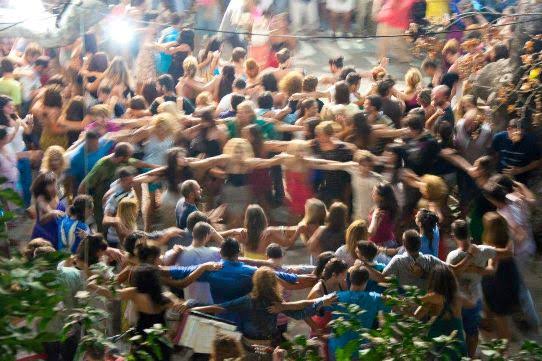
Dancing is one of the most enjoyable parts of a panigiri. Locals form circles, holding hands or placing their arms around one another’s shoulders, and dance to traditional Greek rhythms.
Depending on the region, dances may include the syrtos, ballos and other local dances.
Visitors are warmly encouraged to join in, even if they do not know the steps. There is no need to be an experienced dancer – the important thing is to participate and enjoy the moment.
5. Celebration Until Late at Night
Unlike many organised events, a traditional panigiri often has a relaxed and spontaneous atmosphere. The music continues, the tables remain full, and dancing can last well into the early hours.
It is a celebration where different generations come together, old friends reunite, children play, and visitors become part of the festivities.
6. Greek Hospitality – The Spirit of Philoxenia
Perhaps the most important element of a panigiri is philoxenia, the Greek tradition of welcoming and caring for guests.
Visitors are not expected to remain spectators. They are invited to share the food, enjoy the music, join the dancing and experience the warmth of the local community.
This genuine sense of togetherness is what makes a traditional Greek panigiri so memorable.
A panigiri is not just something you attend – it is something you experience.
Editorial note: Individual customs, processions, food, music and timings vary between villages and years. The description above explains the traditional format.